Why Your Eyes Need More Nutritional Support Than You Think
Most people take their vision for granted — until it starts to fade. Age-related macular degeneration (AMD), cataracts, and chronic visual fatigue affect tens of millions of adults worldwide, and research increasingly points to one overlooked factor: nutritional deficiency. The good news is that science now gives us a clear, actionable map of the nutrients your eyes rely on every day to stay healthy.
In this guide, you will discover the best vitamins and minerals to support eye health naturally — drawn from some of the largest, most rigorous clinical trials in ophthalmological history. Whether you are in your 40s and simply want to protect your long-term vision, or you are already noticing changes in your eyesight, the information here will help you make informed decisions based on peer-reviewed evidence.
You will learn which antioxidants have been proven to slow the progression of macular degeneration by up to 25%, which carotenoids act as the eye’s built-in sunscreen, and which minerals help shuttle critical nutrients directly into your retina. By the end of this article, you will understand exactly what your eyes need — and how to get it.
Before we dive into each nutrient individually, it helps to understand the scale of the scientific evidence behind these recommendations. The two most authoritative sources on nutrition and eye health are the Age-Related Eye Disease Study (AREDS) and its successor, AREDS2, both sponsored by the U.S. National Eye Institute. Together, these two landmark trials enrolled nearly 9,000 participants and tracked their eye health over years, providing the clearest picture we have of how specific vitamins and minerals affect vision as we age.
These studies confirmed that your diet and supplement choices have measurable, significant effects on your risk of serious vision loss — and they identified the precise nutrients responsible for that protection. Here is what the science actually says.
The best vitamins and minerals to support eye health naturally are lutein, zeaxanthin, vitamin C, vitamin E, and zinc — often combined with copper. Clinically validated by the AREDS2 trial, these nutrients protect the retina from oxidative damage, filter harmful blue light, and may reduce the risk of advanced age-related macular degeneration by approximately 25%.
Discover a premium plant-based eye health formula that gives your eyes the clinically backed support they deserve.
The AREDS2 Formula: What the Science Actually Proved
The Age-Related Eye Disease Study 2 (AREDS2) enrolled 4,203 participants aged 50 to 85 across 82 clinical sites in the United States. Participants with intermediate or advanced age-related macular degeneration took daily supplements containing lutein (10 mg), zeaxanthin (2 mg), vitamin C (500 mg), vitamin E (400 IU), zinc oxide (80 mg), and cupric oxide (2 mg).
The results were striking. People who took the full AREDS2 formula reduced their risk of progressing to advanced AMD by approximately 25% compared to those taking a placebo. A long-term follow-up study published in JAMA Ophthalmology confirmed that this protective effect held up across 10 years of follow-up. The AREDS2 formula also replaced the original beta-carotene with lutein and zeaxanthin — a critical refinement, because beta-carotene was found to raise lung cancer risk in smokers.
A major 2023 Cochrane review of 26 studies involving nearly 12,000 participants further confirmed the evidence: antioxidant vitamin and mineral supplementation using the AREDS formula probably slows progression to late AMD with moderate-to-high certainty. More recently, a 2024 NIH-led analysis found that the same AREDS2 nutrients may slow vision loss in geographic atrophy — a late-stage form of dry AMD — by up to 55% over three years. These findings mark a significant expansion of our understanding of when nutritional intervention can help.
Lutein and Zeaxanthin: The Eye’s Natural Sunscreen
Of all the nutrients linked to natural eye health support, lutein and zeaxanthin command the most robust body of evidence. These two plant-derived carotenoids are the only ones the human body selectively concentrates in the retina and lens — and specifically in the macula, the region of the eye responsible for sharp central vision.
Research from the Schepens Eye Research Institute at Harvard Medical School confirmed that dietary zeaxanthin plays an essential protective role against light-induced retinal damage. Lutein and zeaxanthin act as a biological light filter, absorbing high-energy blue-light wavelengths before they can trigger oxidative damage to photoreceptor cells. The higher your macular pigment density — a direct reflection of your lutein and zeaxanthin status — the better your protection.
A comprehensive review published in Annual Review of Nutrition (PMC5611842) confirmed that lutein and zeaxanthin are the exclusive carotenoids found in the neural retina and lens, comprising 80–90% of all carotenoids present in the human eye. These findings elevate lutein and zeaxanthin from helpful dietary additions to functionally essential nutrients for long-term ocular health. In a six-month randomised controlled trial in screen-heavy users, supplementation with 10 mg of lutein and 2 mg of zeaxanthin improved tear film stability, reduced photo-stress recovery time, and supported dry-eye markers compared to a placebo group.
Food Sources of Lutein and Zeaxanthin
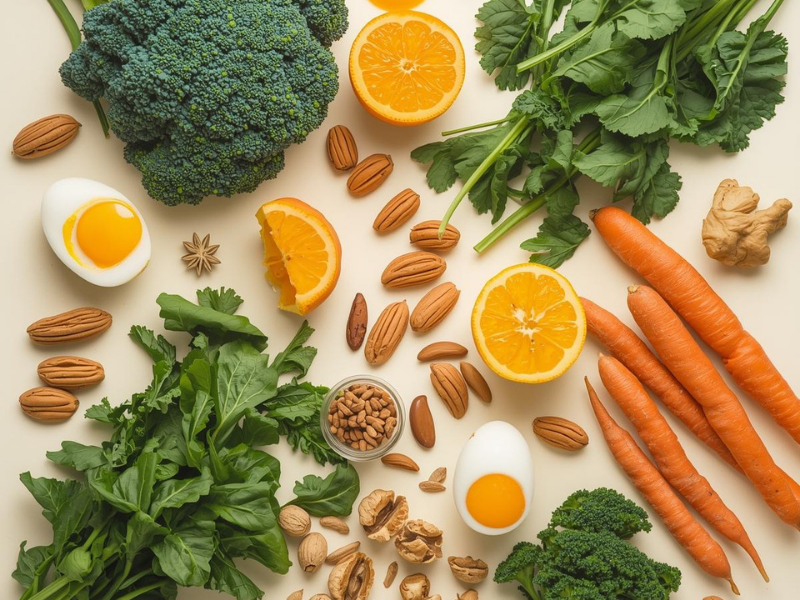
Kale, spinach, Swiss chard, and other dark leafy greens deliver the highest concentrations of these carotenoids. Eggs — particularly the yolk — provide a highly bioavailable form that the body absorbs more efficiently than plant sources alone. Orange peppers, corn, and squash also supply meaningful amounts. Cooking leafy greens lightly with a healthy fat (such as olive oil) enhances absorption significantly.
Vitamin C: Antioxidant Protection for the Lens and Retina
Vitamin C (ascorbic acid) is present in especially high concentrations in the aqueous humor of the eye — the fluid filling the space between the lens and the cornea. This concentration appears to be deliberate: the eye actively accumulates vitamin C as a first line of defence against oxidative stress, which is one of the primary drivers of lens clouding and retinal deterioration.
The AREDS trial used 500 mg of vitamin C daily — roughly five to eight times the typical recommended dietary allowance — as part of its protective combination. Scientific evidence published by the American Academy of Ophthalmology suggests that vitamin C, when combined with other key nutrients, helps slow the progression of AMD and may reduce the risk of developing cataracts. The antioxidant properties of vitamin C neutralise free radicals generated by ultraviolet light exposure, which would otherwise damage the delicate proteins inside the lens.
Dietary sources of vitamin C that specifically benefit visual health include bell peppers (some of the richest sources, gram-for-gram), guava, broccoli, kiwi fruit, citrus fruits, and strawberries. For individuals who struggle to maintain consistent high dietary intake — particularly older adults, whose absorption capacity may decline — supplementation at the AREDS-tested dose is a practical and well-researched option.
Vitamin E: Fat-Soluble Protection Where the Retina Needs It Most
Vitamin E operates as a fat-soluble antioxidant, making it uniquely suited to protect the fatty-acid-rich membranes of photoreceptor cells in the retina. Unlike water-soluble antioxidants, vitamin E embeds directly into cell membranes — the precise location where light-triggered oxidation most frequently occurs. Early experimental evidence from the Schepens Eye Research Institute demonstrated that vitamin E (tocopherol) significantly reduced light-induced retinal damage in animal models, working alongside zeaxanthin to protect photoreceptor integrity.
In the landmark AREDS trial, participants in the high-risk AMD categories who took 400 IU of vitamin E as part of the full antioxidant-plus-zinc combination reduced their risk of vision loss by approximately 19%, with some sub-groups showing odds reductions of up to 48%. It is important to note that vitamin E performed best in synergy with the other AREDS nutrients rather than in isolation — a finding that underlines the importance of comprehensive, multi-nutrient eye support rather than single-ingredient supplementation.
Rich dietary sources of vitamin E include sunflower seeds, almonds, hazelnuts, wheatgerm oil, and fortified breakfast cereals. Sweet potatoes and avocados provide moderate amounts alongside other valuable eye-health nutrients. Because vitamin E is fat-soluble, consuming it with a healthy fat source greatly improves absorption.
Zinc and Copper: The Mineral Team Your Retina Depends On
Zinc is one of the most concentrated minerals in the human eye, with particularly high levels found in the retina and the choroid — the vascular tissue layer that supplies the retina with oxygen and nutrients. Zinc plays a vital structural and enzymatic role: it helps transport vitamin A from the liver to the retina, where it is converted into melanin, the protective pigment that reduces light sensitivity damage. Without adequate zinc, vitamin A cannot perform its vision-protective function regardless of how much of it you consume.
In the AREDS clinical trial, zinc supplementation alone (80 mg of zinc oxide daily) reduced the risk of progressing to advanced AMD by approximately 11% — and when combined with antioxidants, the combined protection rose to 25%. This synergistic effect highlights why ophthalmologists recommend the full AREDS2 combination rather than individual nutrients in isolation. However, because high-dose zinc supplementation can impair copper absorption — potentially causing copper-deficiency anaemia — the AREDS2 formula specifically includes 2 mg of cupric oxide alongside the zinc. This pairing is clinically essential and should always be honoured in supplementation.
Dietary sources of zinc include oysters (the richest natural source), beef, pumpkin seeds, lentils, and chickpeas. Copper is found in liver, cashews, dark chocolate, and sesame seeds. Since high zinc from diet alone rarely reaches supplementation levels, individuals at elevated risk of AMD may benefit most from considering a well-formulated eye supplement that matches the AREDS2 dosing protocol.
Botanical Allies: Ginkgo Biloba, Bilberry, Saffron, and Omega-3s
Beyond the core AREDS2 nutrients, a growing body of research examines botanical compounds that may further complement ocular health. Ginkgo biloba, one of the oldest medicinal plants studied in modern ophthalmology, exerts powerful antioxidative effects and may support retinal microcirculation, helping to maintain adequate blood flow to the eye’s light-sensitive tissues.
Bilberry (Vaccinium myrtillus) is rich in anthocyanins — dark blue-purple plant pigments that support the integrity of blood vessel walls in and around the retina. Some research suggests bilberry may help with night vision adaptation and eye fatigue. Saffron contains the carotenoid crocin, which has attracted growing research interest for its potential to protect photoreceptors and slow retinal degeneration. Preliminary human trials show improvements in retinal function among AMD patients taking saffron supplementation over a period of months.
Omega-3 fatty acids — specifically DHA (docosahexaenoic acid) — are a structural component of the retina’s photoreceptor membranes and are essential for normal visual development. While the AREDS2 trial did not find that omega-3 supplementation added benefit on top of the full formula, observational evidence consistently links diets high in oily fish (salmon, mackerel, sardines) with lower AMD risk. The National Centre for Complementary and Integrative Health (NCCIH) also notes limited evidence suggesting omega-3 supplementation may play a role in managing dry eye disease, a common and often uncomfortable condition affecting screen users and older adults alike.
At a Glance: The Core Eye-Health Nutrients and Their AREDS2 Doses
Nutrition Is Powerful — But It Works Best as Part of a Broader Eye-Care Strategy
Vitamins and minerals exert their most significant protective effects when they are part of a consistent daily routine — not a temporary fix. The AREDS2 participants who benefited most were those who took the supplements every day over a sustained period, underscoring that eye nutrition is a long-term commitment rather than a short-term intervention.
Several lifestyle factors interact meaningfully with nutritional status. Smoking substantially depletes macular carotenoids and increases oxidative load in the eye, counteracting the benefits of even high-quality supplementation. Prolonged UV exposure without protective eyewear accelerates lens and retinal ageing. A diet rich in processed foods and refined sugars creates a pro-inflammatory internal environment that undermines the protective work of antioxidant nutrients. Conversely, a Mediterranean-style diet — rich in leafy greens, oily fish, olive oil, and colourful vegetables — provides a broad array of eye-protective phytonutrients that work together synergistically.
Regular dilated eye examinations remain the gold standard for detecting AMD, cataracts, glaucoma, and diabetic retinopathy at a stage when intervention is most effective. Nutrition supports and slows these processes; it does not replace early clinical detection or treatment. For individuals with intermediate or advanced AMD in particular, the NEI recommends discussing AREDS2 supplementation directly with their ophthalmologist, as the formula is not beneficial for those with early or no AMD.
Protecting Your Vision Naturally: What You Should Take Away
The science is both extensive and consistent: the best vitamins and minerals to support eye health naturally — lutein, zeaxanthin, vitamin C, vitamin E, zinc, and copper — have been validated by decades of clinical research, including the gold-standard AREDS and AREDS2 trials at the U.S. National Eye Institute. These nutrients do not merely fill a theoretical role; they have demonstrated statistically significant, measurable reductions in the risk of sight loss in real patients over multi-year follow-up.
What makes these findings particularly valuable is their precision. We know the nutrients, we know the doses, and we know the populations most likely to benefit. Adults with intermediate AMD, those with a family history of the disease, and individuals with large drusen in their retinas stand to gain the most from consistent, well-formulated supplementation. Younger adults and those with healthy eyes can take meaningful preventive steps through a diet rich in leafy greens, colourful vegetables, eggs, oily fish, nuts, and seeds — the natural food sources of every nutrient discussed in this guide.
Supplementation works best as a safety net that sits on top of a healthy diet and an eye-positive lifestyle — not as a substitute for either. It also works best when you choose a formula that mirrors what the clinical trials actually tested, rather than a combination assembled with insufficient dosing or missing key co-nutrients like copper. The most important action you can take today is to have a conversation with your eye-care professional about your current AMD risk level, and to consider whether a clinically validated supplement formula belongs in your daily routine.
Your eyesight is irreplaceable. The nutrients to protect it are available, well-studied, and accessible. Investing in them now — consistently and with good information on your side — is one of the most prudent decisions you can make for your quality of life in the decades ahead.
Discover a vegan-friendly, plant-based formula that delivers clinically validated nutrition for optimal eye health.
Scientific References
| # | Study / Source | Authors / Organisation | Publication | Key Finding |
|---|---|---|---|---|
| 1 | AREDS Report No. 8 — Vitamins C, E, Beta-Carotene, and Zinc for AMD | Age-Related Eye Disease Study Research Group | Archives of Ophthalmology, October 2001 | PubMed | High-dose antioxidants plus zinc reduced AMD progression risk by ~25% and vision loss risk by ~19% in high-risk participants over 6.3 years. |
| 2 | AREDS2 — Lutein + Zeaxanthin and Omega-3 for AMD (Primary Results) | AREDS2 Research Group; Chew EY et al. | JAMA, 2013 May; 309(19):2005–15 | PubMed | Replacing beta-carotene with lutein/zeaxanthin in the AREDS formula proved more effective and eliminated lung cancer risk in smokers. |
| 3 | AREDS2 Study Design and Baseline Characteristics (Report No. 1) | AREDS2 Research Group; Chew EY et al. | Ophthalmology, 2012 Nov | PMC | 4,203 participants aged 50–85 enrolled; AREDS formula reduced 5-year advanced AMD risk by 25% (28% placebo vs 20% treated). |
| 4 | Long-Term Effects of AREDS Formula on AMD — 10 Year Follow-Up (Report No. 35) | AREDS Research Group | Ophthalmology (PMC) | PMC | 10-year follow-up confirmed sustained protective benefit of the AREDS antioxidant-plus-zinc formula in intermediate/advanced AMD. |
| 5 | AREDS2 Supplements Slow Sight Loss in Late-Stage Dry AMD | Keenan T et al. (NIH National Eye Institute); Co-author: Keane P (Moorfields) | Ophthalmology, 2024 | Macular Society Report | AREDS2 formula may slow geographic atrophy (late dry AMD) progression by up to 55% over 3 years in 1,209 participants. |
| 6 | Cochrane Review: Antioxidant Vitamin and Mineral Supplements for AMD Progression | Evans JR, Lawrenson JG | Cochrane Database of Systematic Reviews, 2023; 9(9):CD000254 | Review of 26 studies (11,952 participants) found moderate-certainty evidence that AREDS supplementation probably slows progression to late AMD. |
| 7 | Lutein and Zeaxanthin Isomers in Eye Health and Disease | Mares J (review); multiple collaborators | Annual Review of Nutrition, 2016 | PMC | Lutein and zeaxanthin comprise 80–90% of carotenoids in the human eye; essential for macular pigment and protection against AMD. |
| 8 | The Photobiology of Lutein and Zeaxanthin in the Eye | Roberts JE, Dennison J | Journal of Ophthalmology, 2015 | PMC | Clinical trials confirm age/diet-related loss of lutein/zeaxanthin enhances phototoxic eye damage; supplementation has a protective effect. |
| 9 | Zeaxanthin and Retinal Protection — Animal Model Evidence | Dorey CK et al. (Schepens Eye Research Institute / Harvard Medical School) | Investigative Ophthalmology & Visual Science, November 2002 | Summary | First direct experimental evidence that dietary zeaxanthin protects the retina from light damage; vitamin E showed similar benefit. |
| 10 | Lutein and Zeaxanthin Supplementation in High Screen Users (RCT) | Loughman A et al., Clinical Research Australia | Frontiers in Nutrition, 2025 | PubMed | 6-month RCT (n=70): 10 mg lutein + 2 mg zeaxanthin improved tear film stability, photo-stress recovery, and dry-eye markers vs placebo. |
| 11 | Dietary Sources of Lutein and Zeaxanthin and Their Role in Eye Health | Abdel-Aal ESM et al. | Nutrients, 2013 | PubMed | Lutein/zeaxanthin protect the macula from blue-light damage, improve visual acuity, and reduce AMD and cataract risk. |
| 12 | Antioxidant Vitamins and Zinc Reduce Risk of Vision Loss from AMD (NEI Statement) | Ferris FL et al.; National Eye Institute | Archives of Ophthalmology, October 2001 | NEI | High-dose combination of vitamins C and E and zinc reduced advanced AMD risk by ~25% and vision loss risk by ~19% in high-risk group. |
| 13 | Dietary Supplements for Eye Conditions: What the Science Says | National Center for Complementary and Integrative Health (NCCIH) | NIH/NCCIH | NCCIH | Confirms AREDS formula probably slows AMD; notes limited evidence for omega-3s in dry eye; current data do not support vitamins for glaucoma. |
Medical Disclaimer
I am not a doctor, ophthalmologist, or licensed medical professional. The information in this article is provided for educational and informational purposes only and does not constitute medical advice, diagnosis, or treatment. The scientific studies cited are publicly available peer-reviewed research, and their findings are presented to inform — not to prescribe. Individual results from nutritional supplementation vary, and no supplement is proven to cure or prevent any eye disease.
If you are experiencing changes in your vision, have been diagnosed with a retinal condition, or are considering starting any supplement regimen, please consult a qualified ophthalmologist or healthcare provider first. This is particularly important if you are pregnant, nursing, taking prescription medications, or have existing medical conditions. Statements about dietary supplements have not been evaluated by the Food and Drug Administration (FDA). No supplement mentioned or linked in this article is intended to diagnose, treat, cure, or prevent any disease.